
Budapest, Hungary’s dazzling capital city sits majestically at the heart of Central Europe where the mighty Danube River gracefully divides the historic Buda hills from the bustling Pest plains. This enchanting metropolis serves as the cultural and economic powerhouse of Hungary while captivating visitors with its stunning architecture and thermal baths.
Located approximately 140 miles southeast of Vienna and 150 miles north of Belgrade the city occupies a strategic position that’s made it a coveted destination throughout European history. Its unique geographic location at the crossroads of Eastern and Western Europe has shaped Budapest into a fascinating blend of cultures making it one of Europe’s most intriguing capital cities.
Budapest’s Geographic Location in Hungary
Budapest sits in north-central Hungary, occupying both banks of the Danube River in the heart of the Carpathian Basin.
GPS Coordinates and Elevation
Budapest’s coordinates are 47°29’33″N latitude and 19°03’05″E longitude. The city covers 525 square kilometers at varying elevations across its terrain. The Buda side rises to 527 meters above sea level at János Hill, while the Pest side maintains a relatively flat elevation between 100-150 meters. The average elevation of Budapest is 108 meters above sea level.
| Geographic Feature | Measurement |
|---|---|
| Latitude | 47°29’33″N |
| Longitude | 19°03’05″E |
| Total Area | 525 km² |
| Highest Point | 527 m |
| Average Elevation | 108 m |
Position Along the Danube River
The Danube River flows for 28 kilometers through Budapest, dividing the city into distinct regions. The river enters Budapest from the north near Újpest and exits southward past Csepel Island. Three major bridges connect the Buda hills on the western bank to the Pest plains on the eastern side:
- Chain Bridge spans 375 meters across the river’s narrowest point
- Margaret Bridge links Margaret Island to both banks
- Elizabeth Bridge connects the city center districts
The river’s presence shapes Budapest’s climate, moderating temperature extremes throughout the urban area.
Regional Context Within Central Europe
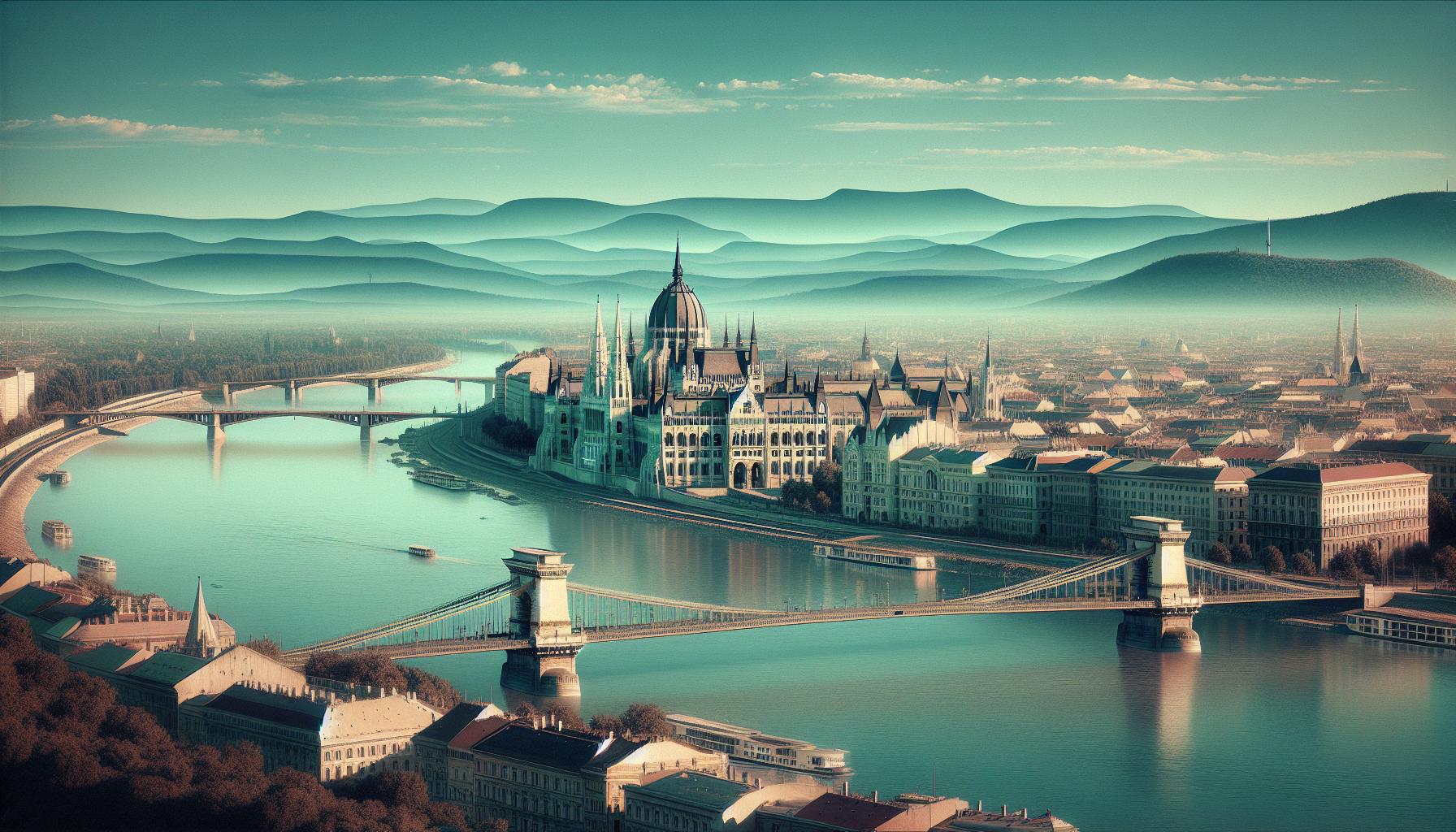
Budapest occupies a strategic position in Central Europe, serving as a gateway between Eastern and Western Europe. Its location at the crossroads of major trade routes enhances its significance as a regional hub.
Distance to Major European Cities
Budapest connects to several major European capitals through efficient transport networks:
| City | Distance (km) | Travel Time by Train |
|---|---|---|
| Vienna | 243 | 2.5 hours |
| Prague | 525 | 7 hours |
| Berlin | 873 | 12 hours |
| Warsaw | 869 | 10.5 hours |
| Zagreb | 345 | 6 hours |
Direct international rail lines link Budapest to 25 European cities. The M1 motorway connects Budapest to Vienna while the M5 provides access to Belgrade.
Budapest’s Strategic Location
Budapest’s position along the Danube River creates a natural transportation corridor through Central Europe. The city sits at the intersection of three major European transport routes: the Mediterranean corridor connecting Southern Europe to Ukraine, the Rhine-Danube corridor linking Western Europe to the Black Sea, and the Orient-East Mediterranean corridor extending from Germany to Greece. Five international railway lines converge in Budapest, making it a central railway hub for freight and passenger transport. The proximity to the Carpathian Basin’s resources contributes to Budapest’s economic advantages in manufacturing and trade.
Budapest’s Position Within Hungary
Budapest occupies a central position in Hungary, serving as both the economic powerhouse and administrative capital of the nation. The city spans across the Danube River, encompassing 525 square kilometers in the north-central region of the country.
Capital City Status and Size
Budapest stands as Hungary’s primary metropolitan center, containing 20% of the country’s population with 1.7 million residents. The city generates 40% of Hungary’s GDP through its diverse economic sectors including finance, technology manufacturing industries. Its strategic location at the intersection of major transportation routes makes it the focal point for Hungary’s commercial activities, hosting the headquarters of multinational companies, government institutions, major universities.
Districts and Urban Layout
Budapest consists of 23 administrative districts, numbered with Roman numerals I to XXIII. Districts I-XII comprise the Buda side, featuring elevated terrain with residential areas nestled in the hills. Districts XIII-XXI occupy the Pest side, characterized by flat terrain with commercial zones, entertainment venues, government buildings. District XXI contains Csepel Island, an industrial zone in the Danube. The city center encompasses Districts V, VI, VII on the Pest side, forming the main business cultural hub with historic architecture, shopping streets, tourist attractions.
Natural Geography of Budapest
Budapest’s topography features a distinctive contrast between the hilly western region and the flat eastern plains, divided by the Danube River. This natural setting creates a diverse landscape that shapes the city’s urban development and cultural identity.
Buda Hills and Pest Plains
The Buda Hills rise up to 527 meters above sea level on the western bank of the Danube, comprising limestone formations with caves, valleys, and forested areas. The highest point, János Hill, offers panoramic views of the entire metropolitan area through its 23.5-meter-high Elizabeth Lookout Tower. In contrast, the Pest side extends across a flat alluvial plain at 100-140 meters above sea level, creating optimal conditions for urban development, agriculture, and transportation infrastructure.
Thermal Springs and Geology
Budapest sits atop a complex geological system containing 123 natural thermal springs that produce 70 million liters of water daily at temperatures ranging from 21°C to 78°C. The thermal water emerges from fractures in the limestone bedrock, enriched with minerals including calcium, magnesium, hydrocarbonate, sulfate, and sodium. These springs support 9 medicinal baths, including the historic Széchenyi Baths complex spanning 6,220 square meters with 21 pools. The geological foundation consists of dolomite rock formations dating back 200 million years, creating a natural aquifer system that feeds the city’s famous spa culture.
Transportation Access to Budapest
Budapest’s comprehensive transportation infrastructure connects the city to major European destinations through multiple modes of travel. The city’s strategic location enhances its accessibility for both business travelers and tourists.
International Airports and Railways
Budapest Ferenc Liszt International Airport serves as the primary gateway, handling 16.2 million passengers annually through direct flights to 153 destinations across 47 countries. The airport connects to downtown Budapest via a dedicated express shuttle bus and taxi services, with a travel time of 25 minutes. Budapest’s Keleti Railway Station operates as Central Europe’s main rail hub, offering high-speed rail connections to Vienna (2.5 hours), Prague (6.5 hours), and Berlin (11 hours). The EuroCity and InterCity networks link Budapest to 25 European capitals through 35 daily international train services.
Major Highway Connections
Hungary’s motorway system centers on Budapest with six major highways radiating from the city. The M1 motorway connects to Vienna in 2.5 hours, while the M5 leads to Belgrade in 3.5 hours. The M7 provides access to Croatia’s coastal regions, and the M3 links to Ukraine through eastern Hungary. Budapest’s ring road system (M0) circumnavigates the city for 108 kilometers, enabling efficient cargo transport and regional connectivity. The road network handles 250,000 vehicles daily, supporting both commercial and private transportation needs.
Conclusion
Budapest stands as a remarkable European capital strategically positioned at the heart of Hungary. Its unique location along the Danube River has shaped its development into a thriving metropolis that seamlessly blends Eastern and Western influences.
The city’s exceptional infrastructure network thermal springs and dual landscape of Buda hills and Pest plains make it a captivating destination. With excellent connectivity to major European cities through air rail and road networks Budapest continues to strengthen its position as a significant cultural economic and transportation hub in Central Europe.
These geographical advantages combined with modern amenities have transformed Budapest into an attractive destination for visitors businesses and residents alike making it one of Europe’s most dynamic capital cities.
